Showing posts with label getting started. Show all posts

Tuesday, October 27, 2015

Beginner Genealogy -- Biographical sketches


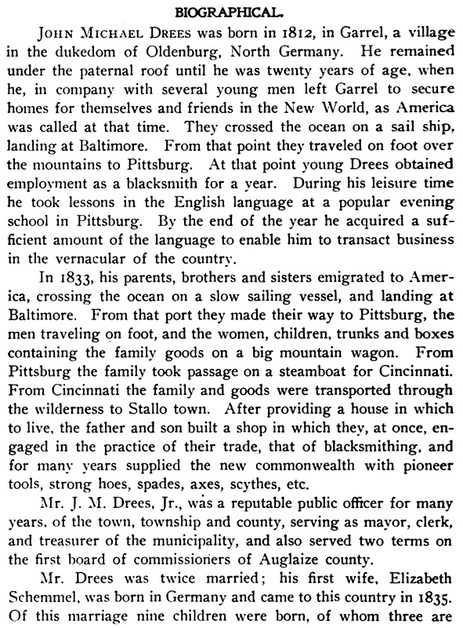
When conducting family history research, sometimes we find interesting facts or anecdotes that we want to share, but maybe this information does not fit into a pedigree chart or family tree. Writing a short biographical sketch about an ancestor is a good way to keep track of anecdotal or more complex or in-depth genealogical data. You can include almost anything in a biographical sketch, but some typical information to provide is: full name; birth, marriage, death location(s) and dates; names of parents, spouses, and children; residence information; stories or legends; accomplishments; occupation, career, military service, and/or education; etc. Many towns and counties will have a "History and Biography" or "Biographical Sketches" of town leaders or pioneers. These relatively brief life stories can be filled with helpful family history leads!

Below are links to a couple of examples of biographical sketches. Remember that bios do not have a particular narrative style, length, or voice. Try your hand at sketching some family history biographies!


Friday, October 23, 2015

Beginner Genealogy -- Collateral Lines

As promised, this post will cover what genealogists call "Collateral Lines." In a nutshell, a collateral relative is a blood relative who is not in your pedigree, or your direct line. An example of a collateral relative would be an aunt, uncle, cousin, niece, nephew, or even your siblings. In genealogical research, these collateral relatives are often many times removed from you, for example you may be searching for a great-great-great-grand uncle. Collateral lines are the lineages of these relatives. When you start researching people who were born several generations back, sometimes your direct ancestors have less of a paper trail than their siblings or other relatives.

It is important to remember that even if you are researching a line that is 2, 3, or more generations removed, eventually a common ancestor will be shared. Then, all of the previous generations before that ancestor are shared for that line. For example, if you research a cousin who shares a 3rd great-grandparent with you, then the 4th great grandparents and generations beyond them are also shared. So, working on collateral lines can lead to excellent genealogical breakthroughs.

Where to start searching for collateral relatives 

U.S. Federal Census
Any source that indicates family relationships is worth looking at. Depending on the year in which you are searching, a US Federal Census record will usually begin by listing the head of household and follow with any other person living at the residence and their relationship to the head of household.

Obituaries
Obits are hit-or-miss when looking for genealogical information. They can be wealth of birth, marriage, and death dates along with maiden names, parents' names, sisters, brothers, children, spouses, etc. They can also be a few sentences regarding funeral arrangements.

Probate records
If a person left a will or an estate, it never hurts to search through the paperwork. When a will is probated, all living individuals who may have a claim to the estate are listed along with their relationships to the deceased.

Marriage license applications
Depending on the year and the state in which the application was filed, public health information was collected from both the bride and groom when they filled out a marriage application.

Family trees
Search Ancestry, Family Search, or other sites the find related family trees. Maybe someone has information on their direct ancestors who are your collateral ones. Many people have family pictures, stories, and even records that may be indirectly related to your family.

Family Bibles
It used to be common practice to keep vital information stored in family bibles--and lots of people kept track this way for generations, creating many possible collateral lines for a descendant to search.

Death certificates
If you are looking for an ancestor's parents, try searching for records related to your ancestor's siblings. If a death record exists and parents names are listed, you will at least have a starting place for research.

Friday, October 16, 2015

Beginner Genealogy -- Brick Walls


Brick walls are probably the most frustrating part of family history research. A brick wall is simply an ancestor for which you are not able to find any leads or break-throughs that can help you move beyond them and find the generation before them. When I first started my genealogy research, I ran into several "brick walls" because most of my research was done using family sources. For an example of a researcher's brick wall ancestor, see our previous post on Joseph Martin (1811-1854). Luckily there are many resources out there to help! Below is a list of 10 steps I take when I hit a brick wall.


My strategy for working past a brick wall

1. Check for variations. It is almost impossible to find someone if you are searching for the wrong name, or the wrong spelling of their name. My great-great grandmother's first name was Jinsey. I have seen it spelled Jency, Jensey, Jencie, Jensie, Jinsie, etc. Her death certificate was on Ancestry.com for months before I found it because I hadn't tried any variation of her name other than the way it was written on her gravestone "Jinsey", which happens to be completely different than the way it is spelled on her death certificate "Jency." I also did not know her maiden name, but that's another story...

2. Look through the records you already have. I have discovered many clues from reviewing sources like census records, marriage certificates, and obituaries. If you are lucky enough to have a valuable resource, search it again for any and every clue that it may yield! I remember reviewing a marriage record to find that one of the witnesses was the bride's father, but he wasn't listed as such because neither party was a minor. He ended up leading me back three more generations for that family!

3. Make a list of records that may be useful. Did you lose your ancestor or family sometime between 1880 and 1900? Maybe that pesky missing 1890 US Federal Census is to blame! After taking a look at the resources I do have, I try to come up with a game-plan for which records I may need. I create anything from a list of missing chunks of time in the person's records so far to a list of document and record types that may be useful.

4. Take a break! There's nothing like stepping away from the situation to clear your head and come back to the research task with a fresh pair of eyes. I use my "break" to work on a completely different line, or use it to step away from genealogy for a few days or weeks.

5. Join a local genealogical society! I am the vice president of my county's genealogy society, so I use those connections when I hit a brick wall. Sometimes talking it out can help to reorganize your thoughts and most of the time another research can point you in the right direction. Other researchers can always give you their opinions on research family history and most of your fellow family historians don't mind helping out!

6. Find similar ancestors and research others like them. Is there something about your ancestor that may make it more difficult to find them? Was he or she undocumented? Was he or she born a slave and later emancipated? Try researching specialized methods for searching for someone of their particular ethnic or national group, or for people of their profession or in the region where they were from. Sometimes a little historical research can lead to fascinating clues.

7. Do local history research. Hanging onto the coattails of the "find similar ancestors" strategy, researching the local history of the region in which your ancestor was born, lived, and/or died can provide the context and historical backdrop for his or her life. County and city history books can be a valuable resource, especially if your ancestor was around for the locality's pioneer days.

8. Go to the library. I'm a librarian, so I'm at my local library all the time! When possible, use local repositories for the area from which your ancestor came, or try to access records online through local public libraries and archives. Remember to call, email, write, or stop in with your research questions. If you can't contact a library or archive for the area you are researching, visit your on local library, preferrably one with a local history and/or genealogy department. Librarians love helping researchers solve mysteries!

9. Research collateral lines. Collateral relatives are those who are not in your direct pedigree, but are blood relatives. These are usually aunts, uncles, cousins, and their families. Our next Beginner Genealogy post will cover this method of breaking through brick walls in more depth, so stay tuned!

10. Helpful websites and blog posts. Another thing I do when I'm taking a break from a brick wall, or when I'm coming back to one, is to read about other researchers' approaches to brick wall research.

Below is a list of other helpful websites and blog posts that contain strategies and ideas for breaking through genealogy brick walls.

20 Things to do when you are stumped Find My Past

Genealogy Research Tips: Breaking through brick walls and getting past dead ends New York Public Library

Brick wall strategies for dead-end family trees About Parenting

Brick wall research GenealogyPro.com

Help for Busting Genealogy Brick Walls Genealogy Insider

Tips for removing stubborn genealogy research blockers Archives.com

Tuesday, September 29, 2015

Beginner Genealogy -- Identify your sources


One important thing to remember about family history research is that you must keep track of your sources! What is a source? A source is anything that contains information you use in your family tree. These can include family sources like oral history interviews, family stories, obituaries, funeral cards, photographs, bibles, and other documents. As you continue researching your family tree, you will begin to find other sources including local records, county and state records, and even national or international records.

The important thing that I cannot stress enough about sources is to DOCUMENT them by providing complete CITATIONS for them. I carry several mantras that I learned in graduate school as an English major and one of them is "Cite your sources." Writing down source information will save you a lot of time and headaches in the future.

Basic citation information for any source will include information such as:
  • Type of document
  • Location of document
  • Author or government agency
  • Page number, volume number, or certificate number
  • Date of document creation or publication
It is also helpful to include:
  • Date of access
  • Location of access (either online website or repository)

For visual learners, Ancestry.com's YouTube channel has a a slide presentation and step-by-step guide to citing sources in your online family tree or your family tree making software.

Friday, September 25, 2015

Beginner Genealogy -- Standard pedigree charts


Now we know how to discover basic genealogical information and how to record it in standard formats. What's next?

Perhaps the most popular chart to start with is a standard pedigree chart. Most are four or five generation charts and trace back to the starting person's great-great-grandparents. The numbering system on the charts is based on the Ahnentafel system, you can learn more about Ahnentafel charts in this previous blog post. Pedigree charts typically have room for full names in addition to the dates and locations of birth, marriage, and death.

Important things to remember about pedigree charts:
  • Begin your first chart with yourself 
  • Provide as much information as you can for each person 
  • On numbered charts using the Ahnentafel system, person #1 is you, #2 is your father, #3 is your mother. Every subsequent man should have an even number and every subsequent women an odd number. 
  • You can make as many subsequent charts as you'd like 


Below is an example of a work-in-progress pedigree chart: 


Tuesday, September 22, 2015

Beginner Genealogy -- How to record basic info.

So, you have collected family history data through family sources and interviews, now what? 

Recording basic genealogical data can be a little overwhelming when you aren't used to genealogical record keeping. Luckily , there are a few basic standards to learn that will get you started. Record your information in standard genealogical forms and charts or family tree computer software. Note: in our next post, we will discuss standard pedigree charts. Below you will find basic genealogy information and the standard way in which genealogists keep track of it. 


Names: first, middle, surname (maiden name only for women)


            Dates for birth, marriage, death: use military style, example: 3 June 1873


            Locations: Record places using town, county, state

Record non-US countries using town, province/shire/county, nation

            Add as many details as you can or want: 

            stories, legends and traditions
            occupations
            biographies
            physical description 
            photos of people, houses, farms, businesses
            military service
            education
            immigration and naturalization
            letters
            family recipes
            transcriptions of oral histories

Sunday, September 20, 2015

Beginner Genealogy -- Where do I start?

A common questions asked of genealogists is "where do I start?" My short answer is simple: start with what you know. Take out a sheet of paper and a pencil and jot down some family history notes.  Make a few phone calls or stop by to visit your aging relatives (if you're lucky enough to have some of those!) Don't be afraid to interview family members and write down everything.You never know when a scrap of information can present itself as a lead later on. Important pieces of information to include are: full names; names of spouses, children, and parents; dates of birth, marriage, and death; locations of birth, marriage, death, or residence;  After exhausting your own memory and those of your family members, look for written family sources. Do you have an old family bible? Photographs? Funeral cards or obituaries? Military papers? Other records? These family sources can be extremely helpful in getting started, even if they are not  properly sourced.

Good luck in getting started! This series of posts will continue with "Beginner Genealogy -- How to record basic info."

For more tips on getting started, visit the FamilySearch "Begin your genealogy quest" page. Are you more into vlogs or webinars? Try watching Ancestry.com's Back to the Basics: Genealogy 101 video on their YouTube channel.

Sunday, August 23, 2015

Resources on the Web: Youtube

When we think of online local history and genealogy resources, it is easy to forget that some of the websites we use daily for other reasons may be packed with genealogical resources as well. Youtube is a great example of this issue. Many of the leading sites that grant access to vital records and provide tree building software, such as Ancestry.com and FamilySearch.org also create and upload helpful videos to Youtube. Ancestry adds how to videos to their channel  whenever a change to the website occurs and they also advertise and demonstrate many of their services as well. They also have a series of videos called the Desktop Education Series that provides expert advice on a variety of research topics. In addition to Ancestry, FamilySearch demonstrates services and provides brief explanations about certain record types, like the 1940 census set. The blogger who calls herself Dear Myrtle also has a Youtube channel.